THE BODYGUARD - DVD review
First, some interesting trivia. Well, at least this stuff is interesting to me, but I'm easy.
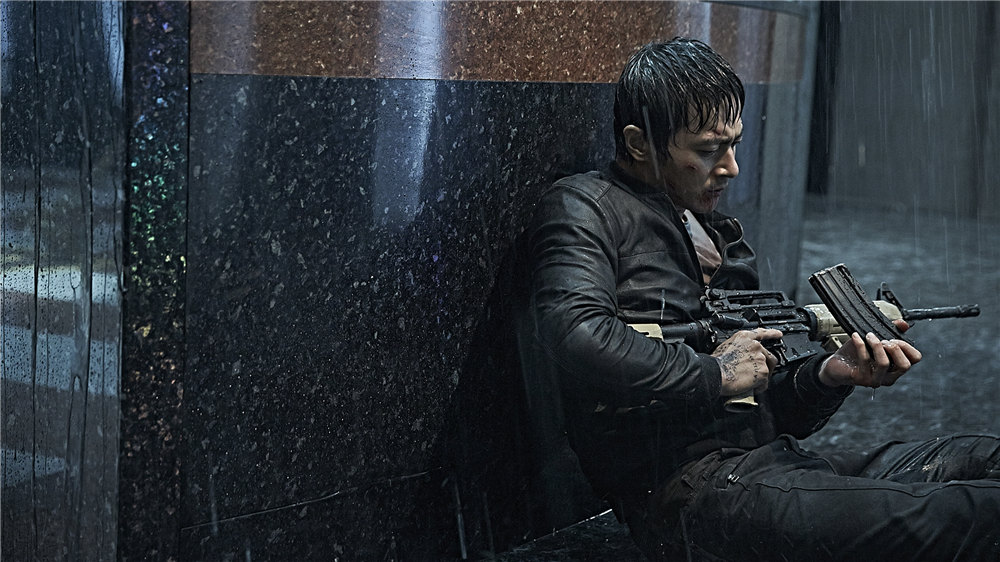
"The Bodyguard" got generally dismal reviews when it was released in 1992 and then went on to take in well over $120,000,000 in U.S. box office receipts and over $400,000,000 worldwide. So much for reviewers. The compact disc of the film's music became one of the biggest-selling soundtrack albums in history. The movie was written in the early seventies as a first-ever script by Lawrence Kasdan, who went on to do a few things you might know, like "The Empire Strikes Back," "Return of the Jedi," "Raiders of the Lost Ark," "Body Heat," "The Big Chill," "Silverado," "The Accidental Tourist," "Grand Canyon," and a couple of yawners, "Wyatt Earp" and "Dreamcatcher." "The Bodyguard" was originally intended for Steve McQueen and Diana Ross, but McQueen bowed out and studios thought the premise too controversial. Then it was going to be made with Ryan O'Neal and Ross, but the two actors had a falling out. Finally, it was championed by Kevin Costner, who stars here with Whitney Houston. Two years after the picture was made, the story was reworked in Hong Kong as "The Defender" (1994) with Jet Li. You can see this thing's been around, and it carries a history.
But is "The Bodyguard" any good? Frankly, I'd have to lump it in with Kasdan's yawners.
The story itself is about as unlikely as a person could imagine, and about as hackneyed as well. Nor does it help that Costner and Houston never exactly light up the screen with their chemistry.
The plot is pretty simple. Hugely rich and successful pop-star, singer, actress Rachel Marron (Houston) is being stalked and threatened by what her personal manager, Bill Devaney (Bill Cobbs) presumes to be a psychotic killer. Ex Secret Service agent Frank Farmer (Costner) is hired to protect her and her and eight-year-old son. Naturally, it's hate at first sight. Rachel thinks Frank is too fussy and overprotective, and he thinks she is arrogant and foolhardy. Just as naturally, the two eventually fall in love. Or in lust, it's hard to tell.
This kind of thing is always happening in fiction. The rich girl is always falling in love with the handsome hired help. It's a chestnut so old that even Mark Twain spoofed it over a hundred years ago in "Adventures of Huckleberry Finn." Tom Sawyer is talking to his band of naive young followers, telling them that if they're going to be a real gang, they have to kidnap people and ransom them. "Say, do we kill the women, too?" asks one of the kids. "Well, Ben Rogers, if I was as ignorant as you I wouldn't let on. Kill the women? No--nobody ever saw anything in the books like that. You fetch them to the cave, and you're always as polite as pie to them; and by-and-by they fall in love with you and never want to go home any more." Tom learned all about this cliché from old potboilers he'd read. And here Kasdan comes up with a variation of the idea for a modern movie.
It's not that the film is all bad. I liked some of the music and Whitney Houston's singing. Not enough to buy the soundtrack album as millions of other people did, but enough to find it pleasant. I liked the house the filmmakers used for Rachel's place, Beverly House in Beverly Hills, California, the location for dozens of other movies (including the famous horse's head mansion in "The Godfather"). I liked the reference in the movie to Kurosawa's tongue-in-cheek samurai saga, "Yojimbo," a film about a warrior who hires himself out (like Costner's character), and a film whose English title was literally "The Bodyguard." I liked Costner's haircut, which is supposed to remind us of Steve McQueen, and I liked the name of Costner's character, Frank. Or perhaps you don't remember one of McQueen's most famous roles, as Frank Bullitt. A proposed chase scene that never came off at the end of "The Bodyguard" might have helped after all. And I liked a couple of the actors. The kid who plays Rachel's son, Fletcher (DeVaughan Nixon), is friendly and agreeable; and the fellow who plays Rachel's security chief, the muscle-headed Tony Scipelli (Mike Starr), is a loveable tough guy.
Beyond that, I dunno. The director was Mick Jackson, who appears to be a rather reserved British chap, known mostly for his television work and the Hollywood films "L.A. Story" and "Volcano." He doesn't seem to have been entirely sure if the script demanded more in the way of earnest reality or out-and-out action, and as a proper gentleman he chose the former course. Someone should have told him the story was a sudsy melodrama, though, because he handles it as seriously as an episode of "Masterpiece Theater." Then, too, the director should have been warned about American editing techniques, which are often chaotic and confusing--long, quick, loud, soft--the shots intermingled in almost random order; they never, for instance, help us to understand why Rachel ever warms up to her cold companion.
"The Bodyguard" is mostly an overlong character study involving two uninteresting people we don't really want to know much about in the first place. Red herrings and coincidences are the only things that disturb the plot's tedium. The last half hour finally begins to generate a modicum of tension, but it doesn't come soon enough. Maybe McQueen knew what he was doing all along. He read the script.
Video:
Warner Bros. first released "The Bodyguard" on DVD in 1997 in fullscreen, a 1.33.1 ratio. I'm sorry I don't have that edition on hand for comparison, but the new version of the movie has been issued in its original theatrical dimensions measuring 1.85:1 anamorphic.
The image itself looks slightly dark, with a somewhat rough edge to it. This may or not be the fault of the transfer; it was, more probably, the condition of the original print. A small degree of grain is most noticeable in darker scenes, as might be expected, and some of these scenes look positively smoke-filled at times. Fortunately, it isn't a big problem, as it occurs infrequently; otherwise, a high bit rate ensures that colors are solid, vivid, and natural, and that detail is reasonably well displayed.
Audio:
The sound has been remastered in Dolby Digital 5.1, and it makes the most of its opportunities. Bass and dynamics are especially strong, and the front-channel stereo spread is often impressive. The surround channels are utilized sparingly, but when they are used, they're effective. Oddly, there isn't a lot of musical ambience in a movie so devoted to continuous pop music; still, during selected scenes, especially action sequences, there is an impressive array of squealing tires and crashing glass spread around the listening area. Applause is also well handled in the surrounds, heightening the feeling of being in actual live locations.
Extras:
There are really only a couple of extras of any note on the disc. The first is a new making-of documentary called "Memories of The Bodyguard." In its twenty-six minutes it features comments by Kasdan, Costner, the film producer, the soundtrack producer, and, in archival footage from 1992, Ms. Houston. For me, however, the whole thing was a little too concerned with people simply extolling the virtues of the film and praising Costner for having the determination to get it made, and not enough actual substance, not enough solid behind-the-scenes material. Oh, well. The second item is a music video of the movie's most famous tune, Dolly Parton's old "I Will Always Love You," sung by Ms. Houston. Beyond these two things, there are thirty-eight scene selections and a widescreen theatrical trailer. The spoken-language choices are English and French; the subtitles are English, French, and Spanish.
Parting Shots:
There are a few nice touches in "The Bodyguard," Houston's singing being one of them. But the film moves rather slowly, and its plot developments are either telescoped well in advance or tacked on to make the story seem more exciting than it really is. If you like the music from the movie, I'd have to say the CD soundtrack might be a better buy than the DVD. But what do I know; I was more interested in the house than the story.