NIGHT OF THE SHOOTING STARS - DVD review
Magical realism makes an uneasy match with memories of WW2 survival in the Taviani Brothers' "Night of the Shooting Stars" (1982).
I have never been a great fan of the Tavianis (Paolo and Vittorio) whose films, to my taste at least, overreach for the oh-so-tasteful, oh-so-elegiac tone that arrives in a shrink-wrapped, ready-for-critical-praise package. All of their films are immaculately filmed which, again to my tastes, is part of what makes them feel so generically art-house, but sometimes the formula works quit well. I enjoyed "Night Sun," the Tavianis' adaptation of Tolstoy's "Father Sergius" quite a bit, though I must admit that I had to go back and read my review before I could really remember anything about it. "Padre Padrone," their 1977 Palme d'Or Winner, is another standout though not really a personal favorite. More often than not, they crank out tediously dignified literary adaptations like "Elective Affinities" (1996).
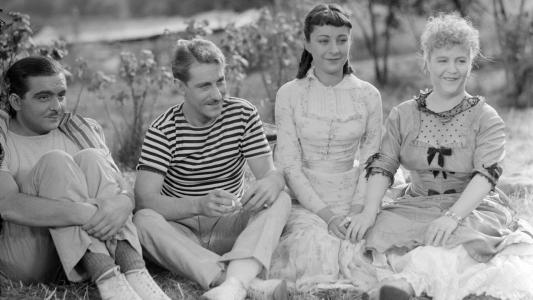
"Night of the Shooting Stars" places on the higher end of the Tavianis' work. Framed as a flashback, an adult Cecilia tells her child a bedtime story about her own youth. When she was six years old in 1944, she and her family and neighbors fled their home town to escape certain death at the hands of Nazi occupiers. Though Cecilia tells the story, it is not told from her point of view; the film has multiple protagonists, in fact. Rather, the tone of the story is colored by a child's half-understanding perspective that can simultaneously perceive wonder and horror with the acceptance that stems from not yet knowing exactly how things are "supposed" to be. Even death can be another matter-of-fact event that only registers on the periphery.
The film has the feel of a fairy tale, but one of those old-fashioned Grimm Brothers' style fairy tale where happy endings are hardly guaranteed. There are numerous beautiful encounters with nature, not to mention intimate encounters between people (that a young Cecilia surely could not have been aware of), but there is also brutality. One of the film's set pieces features a prolonged and frightening shoot-out in a wheat field in which enemies and allies are disoriented (along with viewer) and which stops and starts as many times as, well, a real battle might.
It's a remarkable scene, and worth a recommendation all by itself. The film also explores several adult relationship forged as much out of necessity as genuine emotion (though I suppose there is no real difference when death looms constantly.) Most interesting is the budding romance between two of the older refugees, whose youthful affection had hardened into a lifetime of resentment.
There are other moments I found a bit too precious such as when Cecilia envisions a group of soldiers as Roman warriors raining down spears on their unlucky target though it does create an indelible image, one used in the DVD's liner notes. There's still a sense of sterility that permeates almost all of the Tavianis' work, though I suspect it's largely a matter of personal taste. All films are contrived to some degree but the difference for me is that the Tavianis' films feel so darned contrived. That's not nearly as much of a problem with "Night of the Shooting Stars" as with their lesser work, but it's something I can never shake. I get the same feeling from Theo Angelopoulos even though he (and the Tavianis) is much loved on the festival circuit.
I have allowed my general dislike for the brothers' work to disproportionately tinge my review. "Night of the Shooting Stars" is a fine film and is, you guessed it, beautifully photographed in the Tuscan countryside. Recommended.
Video
The film is presented in a 1.78:1 widescreen aspect ratio. It's a solid transfer from Koch Lorber, but not one without its flaws. The colors look a bit desaturated to my eyes, and the image quality isn't razor sharp, but overall it's a quality effort.
Audio
The DVD is presented in Dolby Digital Mono. Option English and Spanish subtitles support the Italian audio.
Extras
There's only one extra feature but it's a meaty one. "Talking About Cinema" is a feature-length (84 min) interview with the Taviani brothers who discuss their careers and their filmmaking philosophy.
Film Value
Some critics found "Life is Beautiful" to be genuinely appalling for its attempt to re-present the Holocaust as a fairy tale. Viewers won't have the same problem with "Night of the Shooting Stars" which uses the "innocent" perspective of a child to balance the terror and the excitement of life during wartime. And it features the most amazing battle in a wheatfield since Gettysburg.
Koch Lorber has released two other Taviani brothers' film this month which I will not have a chance to review: "Kaos" (1984) and "Fiorile" (1993).
![Cover art for The Conversation [Blu-ray] Cover art for The Conversation [Blu-ray]](http://ecx.images-amazon.com/images/I/51hs7orQk0L._SL160_.jpg)


![Cover art for Terminator 2: Judgment Day (Skynet Edition) [Blu-ray] Cover art for Terminator 2: Judgment Day (Skynet Edition) [Blu-ray]](http://ecx.images-amazon.com/images/I/51xlu9%2BuGcL._SL160_.jpg)